« New Imperium ¦ New Leadership ¦ New Doctrine ¦ New War »
To begin, your platoon needs to be established. You, as platoon commander, have been given the equivalent of 1000 credits to spend. The following table outlines the different classes of personnel and equipment you can use.
| Rank/Type | Maximum Allowed | Cost | Description |
| Lieutenant | 1 | 150 | The platoon lieutenant is the platoon commanders voice in the field. |
| Master Sergeant | 1/8 platoon size * | 120 | Master Sergeants are required to pilot the AT-PT Mk.II. Although the Platoon Commander may purchase as many AT-PT's as he or she likes, they are only permitted to deploy as many Master Sergeants as deemed by the above chart. The small number represents the platoon size that would require the support of one or more AT-PT's. This provides for situations where AT-PT's are required with alternative weapon set-ups. |
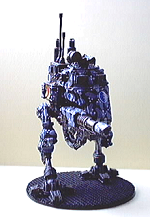
| AT-PT (Mk.II) | ~ | 450 | |
| Sergeant | 1/5 platoon size * | 85 | 1 Sergeant and 1 Corporal in conjunction are required to operate heavy weaponry, such as the Heavy Bolter, Missile Launcher or Anti-Armour Las- / Ion-Cannon. The Sergeant fires the weapon and Corporal assists with reloading. |
| Corporal | 3 | 55 | |
| Lance Corporal | 5 | 30 | The Lance Corporal can take on the role of the field mechanic, radio operator or field medic. |
| Private (First Class) | ~ | 20 | PFC's are the standard trooper used in this type of operation. |
| Cadet | 1/2 platoon size * | 10 | “Green's” performed outstandingly in training, but have never been in combat. |
The remaining rules on establishing a platoon are the same as building a gang in Necromunda.