
« New Imperium ¦ New Leadership ¦ New Doctrine ¦ New War »
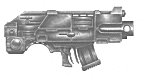
The heavy bolter comes in three different models. The shoulder-mounted version (shown above), the tripod-mounted version, and the vehicle-mounted version.
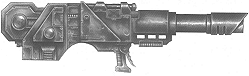
The heavy lascannon comes in three different models. The shoulder-mounted version (shown above), the tripod-mounted version, and the vehicle-mounted version.
The following rules give directions on operation of heavy weaponary that require both a Sergeant and a Corporal to operate.
If the Sergeant is put Down or Out of Action, the heavy weapon becomes useless until another Sergeant is available to operate it.
When a Sergeant is put Down or Out of Action, the Platoon Commander has the choice of
If the Corporal is put Down or Out of Action, the Sergeant can either
In the situation when one of the firing crew is awaiting the other to arrive, they can use his / her side arm, if they have been issued with one.
When operating a heavy weapon or awaiting another crewmember, both are considered Small Targets when being shot at. When moving a heavy weapon, the crew are considered normal targets (i.e. NOT small targets).
When the other half of the firing crew arrives, 1 turn is missed while the Corporal becomes re-acquainted with, and reloads and / or the Sergeant re-aims the weapon.
When the both of the firing crew are operating a weapon, it may be moved a limited distance instead of firing during that turn (up to 2" horizontally, or 1" vertically per turn). When moving a heavy weapon vertically, i.e. up a ladder, to represent the act of climbing, the weapon and crew are placed at the bottom of the ladder, and are unable to fire for the duration of the climb. Once any movement is complete, the firing crew takes 1 turn to set-up, load and aim the weapon.
If no platoon members are available to operate the heavy weapon, and there is a good possibility that it could fall into enemy hands, the Platoon Commander has the option of overloading the weapon, causing an explosion that destroys it. Only Sergeant's and Lieutenant's are capable of overloading a heavy weapon.
On discovering an abandoned heavy weapon, enemy troops can occupy it, taking 1 turn to re-aim and reload the weapon.